


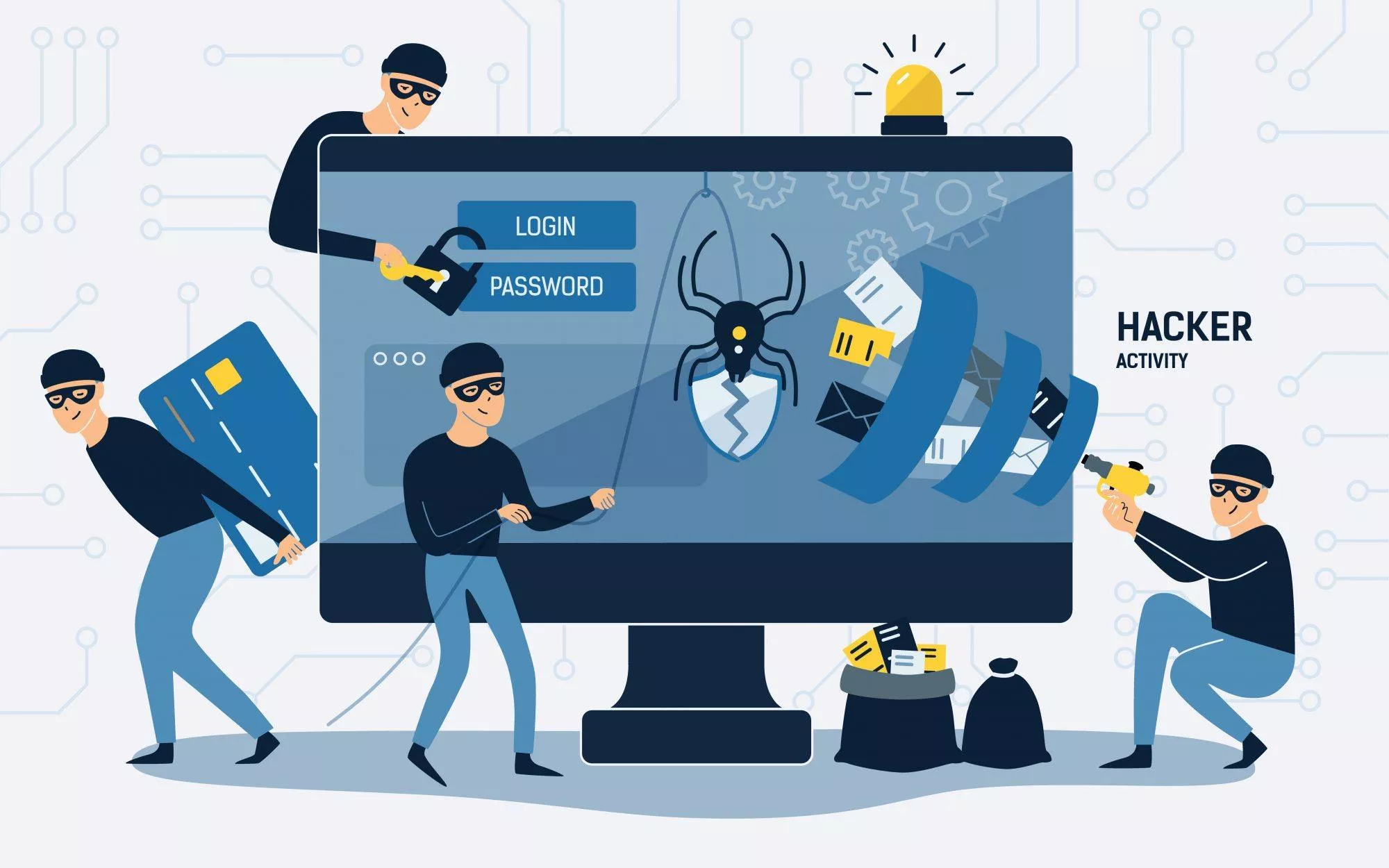
What is a hacker?
When we think of hackers, the thought that usually comes to mind is the bored teenager that tries to take down a bank to have a laugh or the cunning cybercriminal that is lying in wait, somewhere on the internet, ready to infiltrate our computer. But the stereotypes we mentioned above don’t provide an accurate picture of what hackers truly are. We’ll go into this topic in more detail down below, explain what kind of hackers there are and how businesses can protect themselves.
Wat is a hacker?
A hacker is defined as someone that has developed a high level of skill in solving computer issues, but it usually refers to someone that uses their technical expertise to gain access to computer systems that they have no right to. The term ‘hacker’ arose during the 1960s and was originally used to signify someone that could make code run more efficiently by removing excess code from software. ‘Hacker’ is a term that has had both positive and negative connotations for many years. A hacker is sometimes perceived to be a criminal that tries to break into anything digitally by definition, but it’s also a word that carries a certain amount of respect with it: a hacker is a person that is considered to have a certain amount of skill and competence. We can see how these two differing perspectives are reflected in the way that we use these words. Being a hacker is not always considered a negative thing, but it is usually seen as controversial, at least. A life-hack, on the other hand, is nothing more than a cleverer way of doing something. It essentially implies to be a method that gets around the regular systems, just like how a hacker infiltrates digital systems and gains access to classified information.
The different types of hackers
The defining aspect of a hacker then seems to be infiltrating (computer) systems, but that does not necessarily make it malicious. This is why we make a distinction between three different types of hackers. These types are often informally referred to as black hats, white hats and grey hats.
Black Hats: A black hat is a malicious hacker. These are the type of hackers that attempt to gain access to computer systems without authorization, try to steal data, commit identity fraud, take down websites using DDOS-attacks and carry out other harmful actions. These can be criminals, using their skills for their own gain, but black hat hackers also often do this for fun, to test their limits or to gain notoriety.
White Hats: White hat hackers try to use their hacking-skills in a more positive manner. They are also referred to as ‘ethical hackers’ and are often hired by companies or organizations to test their cybersecurity (this is usually done through so-called penetration tests) and subsequently improve it. Because of this, potential weak spots in their cybersecurity can be tracked down before a potential criminal finds them first and wreaks havoc.
Grey Hats: Finally, there are the grey hat hackers, that are somewhere between the black hats and white hats. Grey hat hackers are not really ethical hackers and are usually not hired to help improve cybersecurity. They usually try to break into certain computer systems without authorization, out of curiosity, but they do not have bad intentions and don’t cause the kind of damage that a black hat hacker does. Grey hat hackers may let their target know where the weak spots are and sometimes even offer to solve these problems for them.
How do you become a hacker?
Hacking is a skill that must be practiced extensively. You can’t take a university course to become an ethical hacker, but you can specialize in IT by studying computer sciences, for example. Ethical hackers are required to obtain a CEH-certificate and are often employed as IT Security Consultants. Their work consists of checking systems for weaknesses, carrying out penetration tests and providing recommendations to fix the issues. They sometimes train internal staff for this purpose as well.
How businesses protect themselves against hackers
Understanding what hackers are is one thing. Keeping them out is another. While technical measures like firewalls and VPNs form an important layer of defense, most successful cyberattacks don’t exploit technology — they exploit people. According to research, over 90% of data breaches start with a phishing email that tricks an employee into clicking a malicious link or sharing credentials.
This is why training security awareness has become essential for businesses of all sizes. It teaches employees to recognize threats like phishing, social engineering and suspicious links before they cause damage. Regulations like NIS2 and ISO 27001 now also require organizations to actively train their staff on cybersecurity.
One of the most effective methods within security awareness training is running a phishing simulation: controlled, realistic phishing emails sent to employees to measure how well they can spot a threat. Organizations that combine regular training with phishing simulations see significantly lower click rates over time, reducing the risk of a real attack succeeding.
As you can see, a hacker is not simply a cybercriminal — hacking is a skill that can be used for many positive ends. Still, the internet isn’t always a safe place to be. Protecting your business requires both the right tools and well-trained employees. A VPN like GOOSE VPN secures your connection, while security awareness training ensures your team knows how to recognize and stop threats before they cause harm.